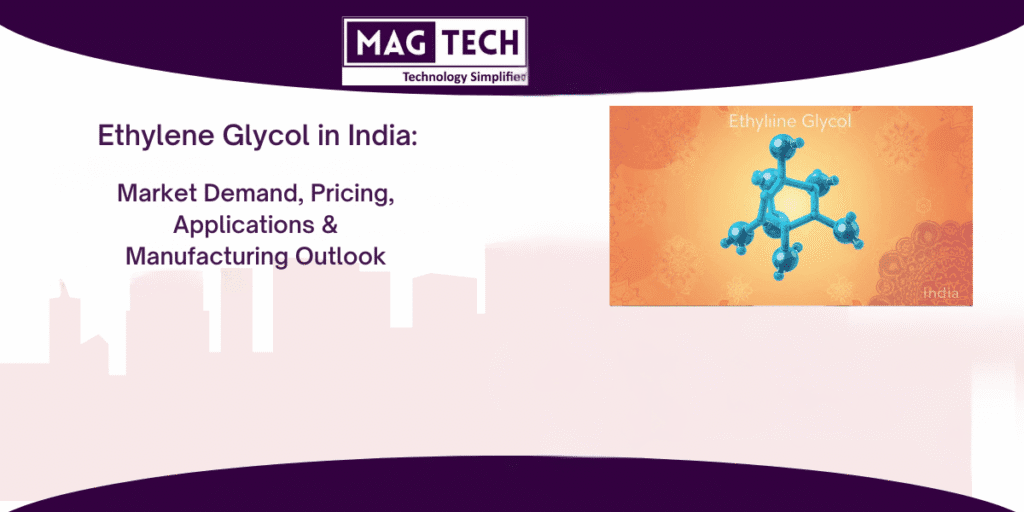
Ethylene glycol is one of the most widely used industrial chemicals in India, forming the backbone of multiple sectors including textiles, automotive, packaging, construction, and antifreeze manufacturing.
As India’s industrial base expands and polyester demand rises, the role of ethylene glycol in India is becoming increasingly strategic. However, market dynamics are influenced by global crude prices, import dependence, domestic production capacity, and end-use industry growth.
This Magtech guide explores:
- What ethylene glycol is
- Industrial applications
- Market demand in India
- Ethylene glycol price per litre trends
- Role of an ethylene glycol manufacturer
- Investment and EPC opportunities
Contents
ToggleWhat is Ethylene Glycol?
(MEG – Mono Ethylene Glycol) is a colorless, odorless, hygroscopic liquid widely used as:
- Polyester fiber raw material
- PET resin intermediate
- Antifreeze component
- Coolant fluid
- Industrial solvent
It is primarily produced through:
- Ethylene oxidation to ethylene oxide
- Hydrolysis to mono ethylene glycol
High-purity grades are used in polyester and PET manufacturing, while industrial grades are used in coolants and resins.
Major Applications of Ethylene Glycol in India
1️⃣ Polyester & Textile Industry (Largest Consumer)
India is one of the largest producers of polyester fiber globally. MEG is a key raw material in:
- Polyester filament yarn (PFY)
- Polyester staple fiber (PSF)
- Textile blends
More than 50% of ethylene glycol demand in India is linked to polyester production.
2️⃣ PET Resin & Packaging Industry
Glycol feedstock is a major component in:
- PET bottle manufacturing
- Food-grade packaging
- Beverage containers
With India’s FMCG and beverage sectors expanding, PET demand continues to rise — directly driving ethylene glycol consumption.
3️⃣ Automotive Coolants & Antifreeze
MEG is widely used in:
- Engine coolants
- Brake fluids
- De-icing solutions
As vehicle ownership increases and infrastructure improves, demand for automotive-grade glycol products continues to grow.
4️⃣ Industrial Resins & Chemical Intermediates
Ethylene glycol is also used in:
- Unsaturated polyester resins
- Adhesives
- Plasticizers
Chemical intermediates
Ethylene Glycol in India: Market Overview
Add Your Tooltip Text Here
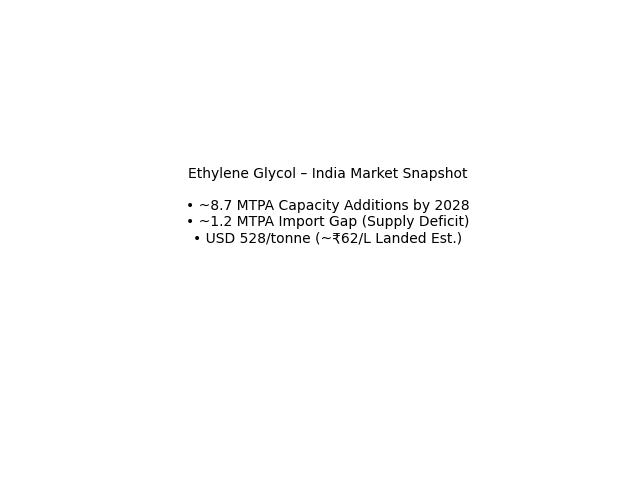
- India is set to add ~8.7 mtpa of ethylene glycol capacity by 2028 — the largest share of global EG additions.
- Domestic shortfall remains significant (estimated ~1.2 mtpa import gap), keeping imports and price sensitivity high.
- Latest contract pricing signals for MEG ~USD 528/tonne CFR (India, Jul 2025) — ~USD 0.65/L (approx.) for quick benchmarking.
India is both a major consumer and importer of ethylene glycol.
Key Market Characteristics:
- Strong polyester sector growth
- Dependence on imported feedstock
- Price sensitivity linked to crude oil
- Growing domestic refining capacity
India’s growing middle class, urbanization, and packaging consumption trends continue to support steady demand growth.
Ethylene Glycol Manufacturer Landscape in India
An ethylene glycol manufacturer typically operates within integrated petrochemical complexes.
Manufacturing Characteristics:
- Ethylene cracker integration
- Ethylene oxide production facility
- Downstream glycol unit
- Large-scale continuous operation
India has both:
- Domestic manufacturers
- Large-volume importers
Because glycol feedstock production is capital-intensive, new entrants typically require significant petrochemical integration or strategic sourcing models.
Ethylene Glycol Price Per Litre in India
1️⃣ Ethylene Glycol Landed Cost Benchmark (India)
Reference Contract Price: USD 528/tonne
Approx. USD per litre: 0.586 USD/L
CIF Price (₹ at 83/USD): ₹48.64 per litre
After Duties (Illustrative Scenario)
Basic Customs Duty (7.5%)
IGST (18%)
👉 Estimated Landed Cost: ₹61.71 per litre
⚠️ Note:
Final procurement price will vary based on:
Freight & port handling
State GST credits
Supplier margin
Currency fluctuations
If you want, I can also generate:
A duty comparison table (0%, 5%, 7.5%, 10%)
Ethylene glycol price per litre fluctuates based on:
- Crude oil prices
- Global ethylene supply
- Import duties
- Shipping costs
- Domestic demand
General Price Influencers:
- Brent crude volatility
- Chinese demand patterns
- Regional supply disruptions
- Currency exchange rate
Unlike specialty chemicals, glycol feedstock behaves more like a petrochemical commodity, making price cycles important for buyers and investors.
⚠️ Buyers should track:
- Monthly contract pricing
- Bulk industrial pricing vs retail packaging pricing
Seasonal fluctuations in coolant demand
Supply Chain & Import Dependence
India imports a significant portion of its ethylene glycol requirements, particularly during peak polyester demand cycles.
Key import sources often include:
- Middle East
- South Korea
- Singapore
This import dependence creates:
- Price vulnerability
- Logistics sensitivity
Opportunity for domestic capacity expansion
Growth Drivers for Ethylene Glycol in India
1️⃣ Textile Industry Expansion
India’s textile exports continue to grow, supported by:
- Government incentives
- Production-linked schemes
- Rising global demand
Polyester remains cost-effective, increasing MEG consumption.
2️⃣ Rapid Urbanization
Urban housing growth increases demand for:
- Polyester furnishings
- Packaging
- Automotive products
3️⃣ FMCG & Beverage Industry Growth
PET bottle demand is directly tied to:
- Soft drink industry
- Packaged water
- Food packaging
Each growth cycle drives additional ethylene glycol demand.
4️⃣ Infrastructure & Automotive Sector
Growing vehicle production and infrastructure development raise demand for coolants and industrial applications.
Investment & Manufacturing Outlook
MEG manufacturing requires:
- Ethylene feedstock access
- Large-scale petrochemical infrastructure
- Advanced process control
- High capital expenditure
Because of this, most ethylene glycol manufacturers operate as part of integrated refinery systems.
However, investment opportunities exist in:
- Storage & distribution
- Bulk trading
- Downstream chemical processing
PET and polyester manufacturing
Risks & Market Volatility
Like other petrochemicals, ethylene glycol is exposed to:
- Oil price volatility
- Geopolitical supply disruptions
- Currency fluctuations
- Chinese production influence
Buyers should manage:
- Inventory risk
- Contract structures
- Hedging strategies
Who Buys Ethylene Glycol in India?
Major buyers include:
- Polyester fiber manufacturers
- PET resin producers
- Automotive coolant manufacturers
- Chemical processing industries
Industrial buyers typically purchase in:
- Bulk tanker loads
- ISO containers
Drums (for smaller industries)
Planning to enter the pharma-grade glycerin market in India?
Request a market + technical feasibility assessment before investing in purification infrastructure.
Click HerePrimarily for polyester fiber and PET production, along with coolants and industrial chemicals.
The polyester textile sector consumes the majority of MEG produced or imported.
Crude oil prices, import supply, shipping costs, and seasonal demand influence pricing.
India produces a portion domestically but still relies significantly on imports.
It can be, but margins depend heavily on price cycles and sourcing strategy.
Future Outlook for Ethylene Glycol in India
Glycol feedstock demand in India is expected to grow steadily due to:
- Expanding polyester production
- Increasing PET packaging usage
- Rising automotive demand
- Growing urban population
While price volatility will remain, long-term demand fundamentals remain strong.
Strategic Conclusion: Long-Term Outlook for the Indian Glycol Value Chain
India’s growth story across textiles, packaging, infrastructure, mobility, and consumer goods ensures that glycol derivatives will remain deeply embedded in industrial development for decades to come. What makes this segment particularly important is not just the scale of demand, but the interconnected nature of upstream petrochemicals, downstream manufacturing, logistics networks, and export competitiveness.
As domestic polyester capacity expands and PET packaging demand continues rising, procurement strategies will increasingly focus on supply security, feedstock reliability, and price risk management. Buyers are no longer evaluating chemical inputs purely on spot pricing; instead, they are considering long-term contracts, supplier credibility, integration capability, and logistics efficiency. In this environment, companies that understand procurement cycles, import exposure, and contract negotiation dynamics will gain a competitive advantage.
Capacity additions announced by major integrated petrochemical players indicate that India aims to reduce import dependence over time. However, commissioning timelines, ramp-up phases, and feedstock alignment will determine how quickly domestic supply stabilizes. Until then, market participants must navigate volatility driven by crude price fluctuations, global demand cycles, and currency movements.
For manufacturers and traders, this means building resilient supply chains. For investors, it means evaluating projects not only from a production standpoint but from a full lifecycle economics perspective — including storage infrastructure, working capital requirements, and downstream integration opportunities. For end users, it means balancing contract coverage with spot exposure to optimize cost.
Looking ahead, the Indian chemical sector is transitioning toward scale, sophistication, and global integration. Success will favor players who combine operational efficiency, strategic sourcing, financial discipline, and compliance rigor. Rather than viewing this segment as a simple commodity market, stakeholders should approach it as a strategically evolving industrial ecosystem where timing, integration, and disciplined execution determine long-term profitability.
In that broader context, market participants who continuously monitor pricing benchmarks, capacity additions, import trends, and end-use industry performance will be better positioned to manage volatility and capture growth opportunities across the value chain.