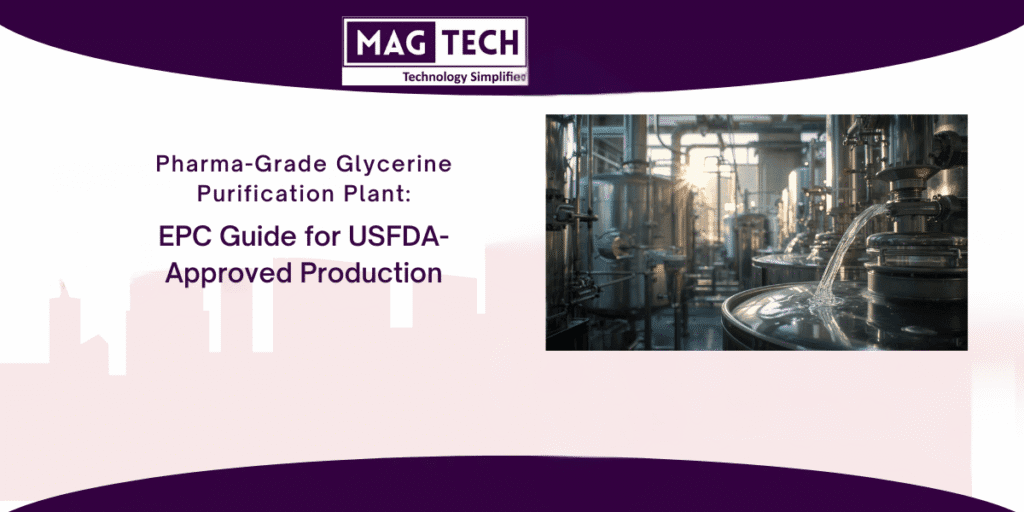
Crude glycerine is no longer a low-value by-product. With rising demand for glycerine purification from pharmaceutical, cosmetic, food, and export markets, pharma-grade glycerine (USP / IP / BP) has become a high-margin opportunity—but only when produced through a properly engineered purification plant.
Many investors underestimate the technical gap between crude or technical-grade glycerine and USFDA-approved pharma-grade glycerine. In reality, the difference lies not just in equipment, but in process design, compliance discipline, and EPC execution quality.
This blog on glycerine purification provides an EPC-level reality check on setting up a pharma-grade glycerine purification plant, covering process technology, compliance requirements, cost drivers, risks, and ROI considerations.
What Is Pharma-Grade (USP) Glycerine?
Pharma-grade glycerine—also referred to as USP / IP / BP glycerine—is a high-purity (>99.5%) glycerol used in:
- Pharmaceutical formulations
- Oral syrups and injectables
- Cosmetics and personal care
- Food and nutraceutical products
Unlike industrial glycerine, pharma-grade glycerine must meet strict impurity limits for:
- Methanol
- Water content
- Color & odor
- Heavy metals
- Organic contaminants
Achieving this purity consistently requires a dedicated purification plant, not a cosmetic upgrade to crude glycerine systems.
Sources of Crude Glycerine for Purification
Most purification plants process crude glycerine generated from:
- Biodiesel plants (UCO, animal fat, vegetable oil based)
- Oleochemical processes
- Soap manufacturing units
Important EPC Insight:
Crude glycerine quality varies widely. Feedstock variability directly impacts purification complexity, operating cost, and yield—a factor often ignored in early-stage planning.
Glycerine Purification Process: EPC-Level Overview
Pharma-grade glycerine production is process-intensive, not equipment-heavy. A typical purification train includes:
1. Pre-Treatment & Neutralization
- Removal of soaps, salts, and free fatty acids
- Acid neutralization and phase separation
Poor pre-treatment increases downstream fouling and utility cost.
2. Methanol Removal
- Vacuum evaporation or distillation
- Critical for pharma compliance
Residual methanol is one of the most common rejection reasons in export audits.
3. Vacuum Distillation
- Core purification step
- Operated under deep vacuum to avoid thermal degradation
- Produces high-purity glycerine fractions
This is where engineering precision matters most.
4. Polishing & Filtration
- Activated carbon treatment
- Fine filtration for color, odor, and trace impurities
5. Pharma-Grade Storage & Handling
- SS316L storage tanks
- Hygienic transfer systems
- Contamination-controlled packaging
A pharma plant is judged as much on handling discipline as on product purity.
USFDA & Pharma Compliance Requirements (Non-Negotiable)
To supply pharma or regulated export markets, the plant must align with:
- USP / IP / BP specifications
- USFDA GMP principles
- Material traceability & batch records
- Validation of critical process parameters
- Clean-in-place (CIP) systems
- Controlled utilities (water, steam, vacuum)
Retrofitting compliance after commissioning is expensive and risky.
Compliance must be designed into the EPC stage, not added later.
Capital Cost (CAPEX) of a Glycerine Purification Plant
Plant Capacity | Typical CAPEX Range |
Small (5–10 TPD) | ₹4–6 crore |
Medium (20–30 TPD) | ₹7–12 crore |
Large (50+ TPD) | ₹15–25+ crore |
Key Cost Drivers
- Vacuum distillation system design
- Material of construction (SS316L vs SS304)
- Automation & instrumentation
- Compliance documentation & validation scope
EPC Reality:
Cheaper plants often compromise on vacuum integrity, metallurgy, or control systems, leading to unstable quality and failed audits.
Operating Cost & Profitability (OPEX & ROI)
Major OPEX Components
- Power and utilities (vacuum systems are energy-intensive)
- Chemicals for pre-treatment
- Activated carbon and consumables
- Skilled manpower
- Quality testing and compliance upkeep
Profitability Snapshot
- Pharma-grade glycerine commands 2–4× price premium over crude glycerine
- Typical ROI timeline: 2.5–4 years, depending on feedstock sourcing and market access
Plants with integrated biodiesel + purification units often achieve faster payback due to captive crude glycerine supply.
Common Mistakes Investors Make
- Assuming crude glycerine quality is “good enough”
- Copy-pasting industrial distillation designs
- Ignoring validation and documentation scope
- Underestimating USFDA audit expectations
- Choosing equipment suppliers instead of EPC partners
Most project failures occur after mechanical completion, during stabilization and audits.
Why EPC Design Determines Approval Success
A pharma-grade glycerine plant succeeds when EPC design ensures:
- Stable vacuum across operating loads
- Tight control of temperature profiles
- Low thermal degradation
- Consistent batch-to-batch purity
- Audit-ready documentation
In regulated markets, yield without compliance is worthless.
Planning a pharma-grade glycerine purification project?
Get a process & compliance feasibility assessment from our EPC team.
Click HereWho Should Invest in a Glycerine Purification Plant?
Suitable For:
- Biodiesel manufacturers with excess crude glycerine
- Export-oriented chemical producers
- Pharma / cosmetic ingredient suppliers
- Investors targeting regulated markets
Not Suitable For:
- Traders without feedstock control
- Cost-only driven buyers
Projects without compliance patience
FAQs: Pharma-Grade Glycerine Purification Plant
Typically ≥99.5% glycerol with strict impurity limits as per USP/IP/BP.
For exports to regulated markets and pharma customers, USFDA-aligned GMP compliance is essential.
Yes—but only with proper pre-treatment, vacuum distillation, and polishing stages.
Under-designed vacuum systems and poor compliance planning.
A pharma-grade glycerine purification plant is not a commodity project. It is a compliance-driven, process-sensitive manufacturing system where EPC quality determines market access, not just output.
When engineered correctly, it converts a low-value by-product into a globally tradable, high-margin product.
Evaluating a USFDA-approved glycerine purification plant?
Request a techno-commercial proposal and compliance roadmap from our EPC team.